
Mary Magdalene Goes to the Synod: Sample letter(s) to send to your Bishop or Delegate
Dear [fill in the name of your delegate],
Dear [fill in the name of your delegate],
Accessibility Tools
Dear [fill in the name of your delegate],
Dear [fill in the name of your delegate],

On June 10, 2016, the Vatican announced that Pope Francis elevated the July 22nd observance of Mary Magdalene from a memorial to a liturgical feast. This action places Mary Magdalene’s feast on par with those of the male apostles recognizing her role as the primary witness to the Resurrection and a key figure in our salvation history.
The decree announcing the change, which was issued by the Congregation for Divine Worship and the Discipline of the Sacraments, calls the entire Church “to reflect in a more profound way on the dignity of Woman” and says that Mary of Magdala can serve as “a paradigm of the ministry of women in the Church.”[i]
In a letter accompanying the decree, Congregation Secretary Archbishop Arthur Roche writes, “St. Mary Magdalene is an example of true and authentic evangelization, that is, an evangelizer who proclaims the joyful central message of Easter.” He also recalls that St. Thomas Aquinas gave Mary of Magdala the title “apostle of the apostles” because she was commissioned by Jesus to go and tell the apostles the good news of his resurrection. He concludes, “Therefore it is right that the liturgical celebration of this woman should have the same level of festivity given to the apostles in the General Roman Calendar, and that the special mission of this woman be highlighted, as an example and model to every woman in the Church”[ii]
The change and abundant accolades may come as a surprise to many Western Christians who have been wrongly taught throughout their lives that Mary Magdalene was a public sinner or repentant prostitute despite all scriptural evidence to the contrary. Modern biblical scholarship has shown that Mary Magdalene was a woman of means who supported Jesus’ Galilean ministry, an important and faithful disciple who remained near Jesus through his crucifixion. Chosen by Jesus to be the first to witness and proclaim his Resurrection, she was an important leader and evangelist in the early Christian community and an essential model for Catholics today.
The centuries-long effort to discredit Mary Magdalene began early in the history of the Church as non-canonical documents show the tensions brewing between communities that upheld Mary Magdalene’s authority up and against those who wanted to raise the authority of men in the figure of Peter. The rise of male authority continued to gain strength into the fourth century, when the Emperor Constantine made Christianity the religion of the Roman Empire, prompting the Church to move away from the inclusive practices of Jesus, St. Paul, and the earliest Christian communities and embrace the patriarchal norms of the Roman Empire. As knowledge of Jesus’ many women disciples and women leaders in the early Christian community began to fade from historical memory, Mary Magdalene’s story was conflated with at least two other women (Mary of Bethany and the anonymous woman of Luke 7:36-50) resulting in what scholars today call the “composite Mary.” Pope St. Gregory I first officially propagated this fallacy during a homily he delivered in around 591:
She whom Luke calls the sinful woman, whom John calls Mary, we believe to be the Mary from whom seven devils were ejected according to Mark. What did these seven devils signify, if not all the vices? It is clear, that the woman previously used the unguent to perfume her flesh in forbidden acts. What she therefore displayed more scandalously, she was now offering to God in a more praiseworthy manner. She had coveted with earthly eyes, but now through penitence these are consumed with tears. She displayed her hair to set off her face, but now her hair dries her tears. She had spoken proud things with her mouth, but in kissing the Lord’s feet, she now planted her mouth on the Redeemer’s feet. For every delight, therefore, she had had in herself, she now immolated herself. She turned the mass of her crimes to virtues, in order to serve God entirely in penance.[iii]
Thus, Mary Magdalene’s reputation was hijacked and her true role hidden from Western Christians for fourteen centuries. It should be noted that the Eastern Church never accepted this “composite Mary” but honored her throughout history as the “Apostle to the Apostles.”
Interestingly, this elevation to the rank of feast isn’t the first change made to the annual celebration of Mary Magdalene in recent history. The post-conciliar reform of the General Roman Calendar in 1969 brought changes to the July 22nd memorial in what seems to have been a first – if quiet and ineffective – attempt to reject the “composite Mary” of Pope St. Gregory I:
No change has been made in the title of today’s memorial, but it concerns only Saint Mary Magdalene, to whom Christ appeared after his resurrection. It is not about the sister of Saint Martha, nor about the sinful woman whose sins the Lord forgave[iv]. . . it will make mention neither of Mary of Bethany nor of the sinful woman of Luke 7:36–50, but only of Mary Magdalene, the first person to whom Christ appeared after his resurrection[v]
The Gospel reading for the day changed from the story of the sinful woman of Luke to John 20:1-2, 11-18, which recalls Jesus’ first appearance to Mary Magdalene and his subsequent commissioning of her to go and tell the other apostles. At that time, Mary of Bethany’s memorial was moved to July 29th.
Still, centuries of bad exegesis and false history, preaching, art, and story-telling were not erased from the Western Christian imagination by the quiet changes and a few notes in the revised General Roman Calendar. And so the falsehoods attached to her reputation and the systemic misogyny it represented — lived on.
As a young organization, FutureChurch would take up Mary Magdalene’s cause with Co-founder Christine Schenk leading. In 1997, FutureChurch launched its international campaign to restore Mary Magdalene to her rightful place as apostle to the apostles.
Twenty-three celebrations were held that first year. Sponsors were asked to invite a biblical expert to trace Mary’s true story as presented in scripture. The presentations were followed by a prayer service at which women presided, preached and encouraged attendees to reflect on their own encounters with — and witness to — the risen Christ.
With each passing year the movement grew. In 2016, FutureChurch learned that more than 300 individuals and communities around the world who were hosting a celebration. As the movement grew, creativity abounded. There were many great speakers and preachers, musical celebrations, liturgical dance programs, dramatic reenactments of women leaders in the Church, and countless other variations on the original structure – all of them celebrating the true Mary of Magdala.
Since initiating the world-wide celebrations, FutureChurch has taken additional steps to educate Catholics – including members of the hierarchy – on the true role of Mary Magdalene.
While no single person, organization, campaign, effort or event can claim all the credit for the the elevation, FutureChurch supporters and members certainly played a critical role through their participation in the organization’s nineteen-year effort. Sister Christine Schenk notes:
It’s not often that working to be the change we long to see actually happens in one’s own lifetime. I am extraordinarily grateful for the providence of God, and for the powerful Holy Spirit energy at work in literally tens of thousands women and men over the past 19 years. This would not have happened without them.[vi]
While the most recent change is an important milestone in the history of the Church and in FutureChurch’s effort to restore Mary Magdalene to her rightful place, there is still much work to be done to create equality among genders in Catholic Church. FutureChurch will continue to point out injustice in the Church, to stand up for women’s ministry and leadership, to educate, to empower, and to tell the true story of Magdalene, and to lift up the witnesses of women throughout the centuries who spread the Good News.
[i]Decree: the celebration of St. Mary Magdalene raised to a feast in the General Roman CalendarJune 10, 2016.
[ii]”Mary Magdalene, Apostle of the Apostles.” Vatican.va. 10 June 2016. Web. 16 Aug. 2016.
[iii]Carroll, James. “Who Was Mary Magdalene?” Smithsonian.com. June 2006. Web. 16 Aug. 2016.
[iv]Calendarium Romanum(Libreria Editrice Vaticana, 1969), p. 131
[v]Ibid, p. 98
[vi]Schenk, Christine, CSJ. FutureChurch’s 2016 Mary of Magdala Celebration. Cleveland, Ohio. 27 July 2016.

During all the phases of the synodal process, faith-filled Catholics across the world concurred regarding the pressing need to re-envision women’s roles in the life, ministry, and governance of the Church. In the October 2023 synod synthesis, participants agreed it was “urgent to ensure that women can participate in decision-making processes and assume roles of responsibility in pastoral care and ministry” (Part II, Section 9, m).
It is urgent to ensure that women can participate in decision-making processes and assume roles of responsibility in pastoral care and ministry (Part II, Section 9, m).
Further, synod participants rightly perceived the relationship between women’s full participation in the Church and the language, images, and narratives that represent women in our liturgical life. Thus, synod participants also proposed changes so that liturgical texts, including the lectionary, include “a range of words, images, and narratives that draw more widely on women’s experience” (Part II, Section 9, q).
There is a need to ensure that liturgical texts and Church documents are more attentive to the use of language that takes into equal consideration both men and women, and also includes a range of words, images and narratives that draw more widely on women’s experience (Part II, Section 9, q).
There is something of consequence at stake for women and for the church as a whole in the choice of scripture passages which are heard in the regular Sunday morning assembly. The ways in which we understand and know God are formed within the liturgy of the church. What we pray and sing, as well as the stories we re-tell in public worship form and shape what we believe about God, ourselves, and our relationship to God and to each other.
Thus, we might ask, “Do the passages selected over the three-year cycle help or hinder us in dealing with what it means for women to have a full and equal role in both church and society? Do the lections chosen praise women for being subordinate or cast them as people who brought sin into the world? Are the stories about women which are in the Bible adequately represented in the lectionary, or does the choice of Sunday readings give the impression that the Bible, and thus our salvation history, is even more male-cemtered than it actually is?”
The insights of synod participants regarding the need to be more inclusive of women’s narratives in our lectionary have been noted by other prominent scholars and officials since the Second Vatican Council. They have raised awareness about the omission of women from the lectionary recognizing that, as Pope Benedict XVI stated, “without the generous contribution of many women, the history of Christianity would have developed very differently,” adding that the “female presence in the sphere of the primitive Church” was in no way “secondary.”
In 1993, the Pontifical Biblical Commission asked that lectionary readings be “more abundant, more varied, and more suitable” and in 2008, the participants at the Synod on the Word, in Proposition XVI asked that “an examination be carried out of the Roman Lectionary to see if the current selection and ordering of the readings is truly adequate to the mission of the church in this historical moment.”
The late Sr. Ruth Fox, OSB, in her respected analysis, “Women in the Bible and the Lectionary” wrote,
A careful analysis of the lectionary reveals that a disproportionate number of passages about the women of the Bible have been omitted. Women’s books, women’s experiences and women’s accomplishments have been largely overlooked in the assigned scripture readings that are being proclaimed in our churches on Sundays and weekdays.
Other prestigious Catholic scholars affirm Sr. Fox’s insights and have written extensively about the “woman gaps” in our Catholic lectionary showing how biblical passages that feature women as prophets, leaders, co-workers, apostles, disciples, deacons, patrons, and ministers in the New Testament and the Hebrew Scriptures are excluded on Sundays and holy days, relegated to weekdays when few will hear the readings, or made optional. In referring to the omission of readings about women in our lectionary, Professor emerita Katherine Tillman of Notre Dame further notes that “if women’s stories are omitted from the readings, they are not likely to appear in homilies.”
While the Church has honored the contributions of women in important ways, there is a lacuna when it comes to proclaiming their stories of faith, courage, and leadership at mass depriving the faithful of the inspirational narratives of our foremothers in faith whose courage, ministry, sacrifice, and tenacity expanded Christianity throughout the world and shaped our tradition in essential ways. These overlooked stories have the effect of silencing the voices of our foremothers in faith whose voices are indispensable in our broken world today.
Women in the Bible and Lectionary by Sr. Ruth Fox, OSB (text)
Amnesia in the Lectionary by Regina A. Boisclair (audio) (text, Women in Theology)
We Must Restore the Powerful Witness of Women Leaders to the Catholic Lectionary by Sr. Christine Schenk, CSJ (text)
Lectionary Readings that Subordinate Women by FutureChurch (text)
Mary Magdalene: Witness, Leader, Disciple, and Apostle to the Apostles by Sr. Christine Schenk, CSJ (text)
Rereading Biblical Women by Dr. Jamie Waters (video, Boston College)
We Need More Women in the Lectionary by Jean Kelly
Restoring John 20: 1 – 18 to our Easter Sunday Lectionary – (With comparison between U.S. reading and Canadian reading) (text)
Reading the Bible in the Lectionary: Gift and Challenge by Sr. Eileen Schuller, OSU (text) (video)
The Feast of St. Phoebe by Sr. Carolyn Osiek, RSCJ (text) (video)
Women Erased from the Lectionary by Michael Peppard, Ph.D. of Fordham University (video)
Women’s Prophetic Leadership Changed the Face of the Roman Empire by Sr. Christine Schenk, CSJ (text, Vatican News)
It’s Not All About Eve: Rediscovering the Feminine Faces in the Bible by Sr. Christine Schenk, CSJ (text, America Magazine)

Vatican II’s 1963 “Constitution on the Sacred Liturgy” called for a wider selection of biblical texts to be used at Mass thus opening the Bible to Catholics in brand new ways. On Palm Sunday in 1970, as a result of the mandated changes, a new, three-year cycle lectionary was instituted introducing a greater number of books and passages from the Bible to Catholics, as well as, many more sources for preaching. As a result, Catholics are much better informed about scripture and the stories of faith that form the foundation for the work of the Gospel today.
The current Lectionary (book of those readings) was prepared by an international committee of experts and went into use on Palm Sunday, 1970. It has been minimally revised twice. It includes three-cycles of readings (A, B, C ) for Sundays with the majority of readings coming from Matthew (A), Mark (B) and Luke (C) respectively while the Gospel of John is used for the Easter season, some Sundays in Cycle B, and other times. Weekday readings were organized into a two-year cycle.
The Lectionary cycles present 14 percent of the Old Testament and 71 percent of the New Testament. In contrast, the readings in the 1963 Roman Missal used 1 percent of the Old Testament and 17 percent of the New Testament.
Generally, Catholics believe that the stories they hear proclaimed at mass are, in fact, the “heart” of our foundational faith stories – the stories we need to hear most to nurture and inspire us to carry out the work of the Gospel for today’s world. Determining what would be included in the lectionary was a deliberative process conducted by male. In that process, stories were included and others were left out. Further, an examination of the lectionary reveals that many of the stories of prominent foremothers in faith have been left out.
Sources
Liturgy Reflections: Who is Responsible for our Current Lectionary?
How Are Mass Readings Chosen? by Pat McCloskey, OFM
Main Differences Between 1970 and 1998 Lectionary by Felix Just SJ
The Scandalous (but true) Story Behind ICEL’s 1969 Lectionary for Mass by Paul Innwood

 Mary Magdalene is a saint for our times. Her vision, courage, ministry, and faith are a model for all Catholics, but especially Catholic women who are excluded in the life, ministry, and governance of the Church is so many ways.
FutureChurch’s “Mary Magalene Goes to the Synod” project seeks to build synodal dialogue and discernment around the need to expand the lectionary so that more of our foremothers in faith are represented in the Sunday readings.
The Synod Synthesis calls the entire Church to dialogue and discernment with a particular, “urgent” focus on the role of women in the Church.
Proposal “q” in Part II, Section 9 entitled, “Women in the Life and Mission of the Church” asks that liturgical texts be more inclusive of women’s narratives.
There is a need to ensure that liturgical texts and Church documents are more attentive to the use of language that takes into equal consideration both men and women, and also includes a range of words, images and narratives that draw more widely on women’s experience (q).
As the faithful work together to bring forth a synodal church, we urge renewed dialogue and discernment that will lead to an expansion of the lectionary, especially the Sunday lectionary, so that the inspiring stories of our foremothers in faith will be better represented and proclaimed to all Catholics.
Expanding the lectionary to include more stories of our foremothers in faith is one critically important way to address some of the concerns voiced in the Synod Synthesis.
Many women expressed deep gratitude for the work of priests and bishops. They also spoke of a Church that wounds. Clericalism, a chauvinist mentality and inappropriate expressions of authority continue to scar the face of the Church and damage its communion. A profound spiritual conversion is needed as the foundation for any effective structural change (Part II, Section 9, f).
Further synod participants acknowledged:
Women make up most of those in our pews and are often the first missionaries of the faith in the family. Consecrated women, both in contemplative and apostolic life, are a fundamental and distinctive gift, sign and witness in our midst. The long history of women missionaries, saints, theologians and mystics is also a powerful source of nourishment and inspiration for women and men today (Part II, Section 9, d).
Thus they proposed:
There is a need to ensure that liturgical texts and Church documents are more attentive to the use of language that takes into equal consideration both men and women, and also includes a range of words, images and narratives that draw more widely on women’s experience (q).
While Church texts have honored the contributions of early Christian women, there is a lacuna when it comes to proclaiming their inspirational stories at the Eucharist, especially on Sundays. Therefore, Catholics who hear the Word of God at Sunday Mass, are deprived of the “Good News” of the faith, courage, sacrifice, and ministry of our foremothers in faith, a precious offering for Catholic women and girls, as well as Catholic men and boys.
In light of the Second Vatican Council, prestigious Catholic scholars such as Sr. Carolyn Osiek, RSCJ[i], Sr. Ruth Fox, OSB[ii], Michael Peppard, Ph.D.[iii], Regina Bosclair, Ph.D.[iv], Sr. Eileen Schuller, OSU[v], Sr. Christine Schenk, CSJ[vi] and others have written about the “woman gaps” in our Catholic lectionary noting that many of the biblical passages that feature our foremothers in faith who served as prophets, leaders, co-workers, apostles, disciples, deacons, patrons, and ministers in both the Hebrew Scriptures and New Testament are not proclaimed on Sundays and Holy Days.
 Below is a sampling of the foundational stories about our foremothers in faith that are missing in the Sunday Lectionary or consigned to weekdays where most Catholics do not hear them. Scholarly articles listed at the end of this page offer a more comprehensive understanding of the ways the lectionary could be expanded to offer more stories of women’s faith, courage, leadership, and ministry in the Early Church and in the First/Old Testament.
Easter is the most holy celebration of the year. Yet, when Catholics gather for Mass on Easter Sunday, they do not hear the full story of the Resurrection.[i] They do not hear the inspiring story of Mary Magdalene’s witness of the Risen Christ or Christ’s commission to Mary Magdalene to proclaim the Resurrection to the other disciples. Only John 20: 1 – 9 is proclaimed eclipsing her faith filled actions. John 20: 11 – 18 is not proclaimed until the Tuesday after Easter when few Catholics hear it. And finally, John 20:10 is omitted on both Easter Sunday and Easter Tuesday, part of the pericope that makes it clear that Mary Magdalene alone remained at the empty tomb while the others went home.
In 2016, Pope Francis raised the memorial of St. Mary Magdalene to a feast day with the official title, “Apostle of the Apostles”, and yet, Catholics do not know her story because they do not hear it on Easter Sunday. Thus, are deprived of one of the most important moments in Christian history.
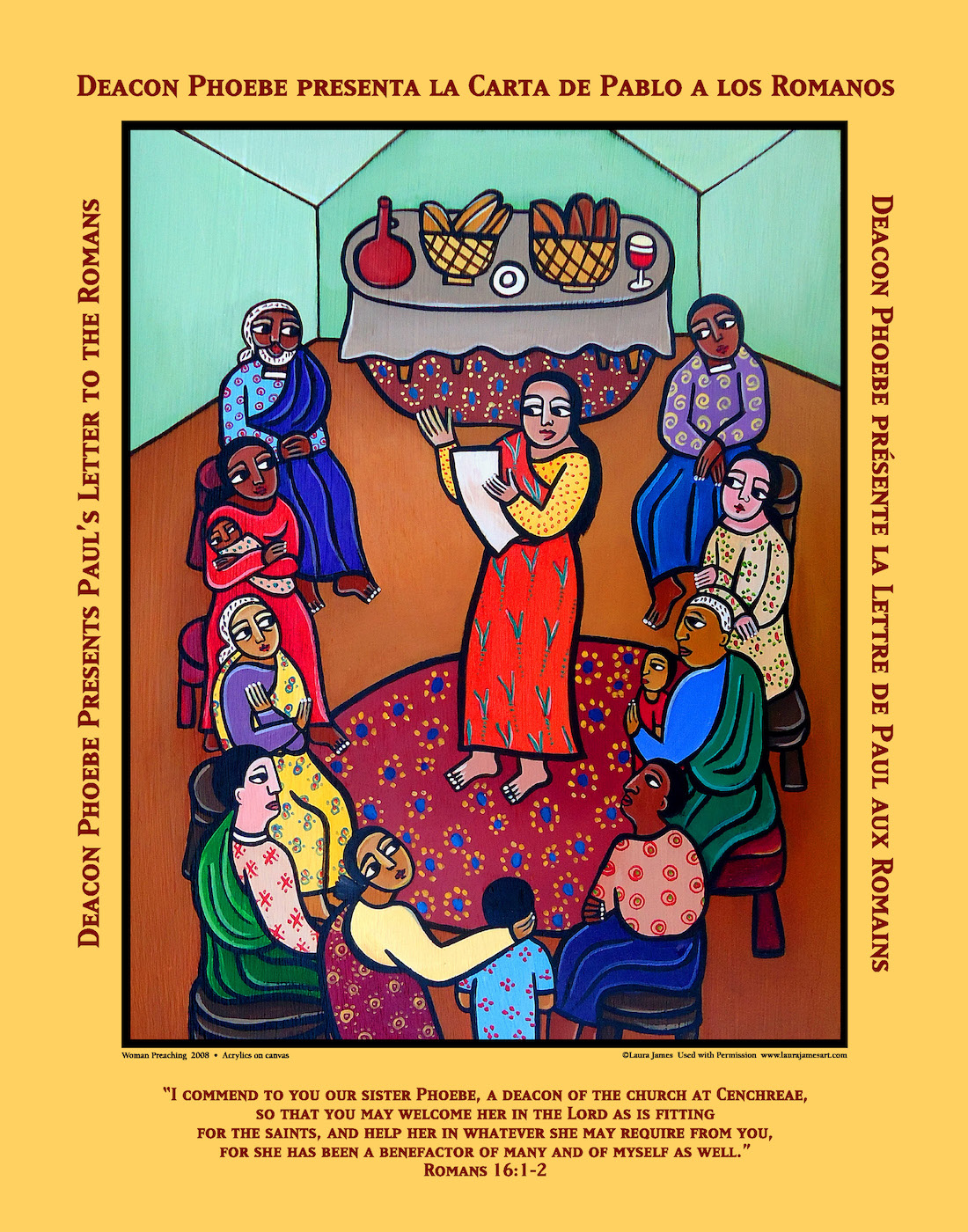 The Eleven Women St. Paul names in Romans 16 whose faith stories are not heard on Sunday
Pope Benedict XVI[ii] noted that St. Paul worked closely with women leaders such as Phoebe, Junia, Lydia and Prisca. Unfortunately, Romans 16, a passage that names 11 women and identifies some as deacons, apostles and co-workers, is never proclaimed on a Sunday. As a result, most Catholics never hear about prominent women who carried out important ministries alongside Paul.
 Courageous Women of the Hebrew Testament
The story of two brave Hebrew midwives, Shiphrah and Puah, is deleted from the lectionary reading describing the enslavement of Israel. The weekday reading of Exodus 1:8-22 (Lectionary #389, Monday of the Fifteenth Week in Ordinary Time, Year I) skips from verse 14 to verse 22, thus eliminating the story of these valiant women who put their own lives at risk to uphold God’s law of life.
In the lead up and during the October 2024 Synod on Synodality we are requesting that synod participants:
Women in the Bible and Lectionary by Sr. Ruth Fox, OSB (text)
Amnesia in the Lectionary by Dr. Regina A. Boisclair (audio) (text from her chapter in Women in Theology)
We Must Restore the Powerful Witness of Women Leaders to the Catholic Lectionary by Sr. Christine Schenk, CSJ (text)
Want to raise awareness about the “women gaps” in the lectionary in your parish?
Here are some ideas.
Sources for this page
[i] USCCB Lectionary reading for Easter Sunday: https://bible.usccb.org/bible/readings/033124.cfm
John 20: 1 – 9
On the first day of the week, Mary of Magdala came to the tomb early in the morning, while it was still dark, and saw the stone removed from the tomb. So she ran and went to Simon Peter and to the other disciple whom Jesus loved, and told them, “They have taken the Lord from the tomb, and we don’t know where they put him.” So Peter and the other disciple went out and came to the tomb. They both ran, but the other disciple ran faster than Peter and arrived at the tomb first; he bent down and saw the burial cloths there, but did not go in. When Simon Peter arrived after him, he went into the tomb and saw the burial cloths there, and the cloth that had covered his head, not with the burial cloths but rolled up in a separate place. Then the other disciple also went in,
the one who had arrived at the tomb first, and he saw and believed. For they did not yet understand the Scripture that he had to rise from the dead.
USCCB Lectionary Reading: https://bible.usccb.org/bible/readings/040224.cfm
John 20: 11-18 is read on Tuesday in the Octave of Easter when few Catholics hear it.
Mary Magdalene stayed outside the tomb weeping. And as she wept, she bent over into the tomb and saw two angels in white sitting there, one at the head and one at the feet where the Body of Jesus had been. And they said to her, “Woman, why are you weeping?” She said to them, “They have taken my Lord, and I don’t know where they laid him.” When she had said this, she turned around and saw Jesus there, but did not know it was Jesus. Jesus said to her, “Woman, why are you weeping? Whom are you looking for?” She thought it was the gardener and said to him, “Sir, if you carried him away, tell me where you laid him, and I will take him.” Jesus said to her, “Mary!” She turned and said to him in Hebrew, “Rabbouni,” which means Teacher. Jesus said to her, “Stop holding on to me, for I have not yet ascended to the Father. But go to my brothers and tell them, ‘I am going to my Father and your Father, to my God and your God.’” Mary went and announced to the disciples, “I have seen the Lord,” and then reported what he had told her.
John 20:10 which shows the actions of the male disciples leaving is never read.
10 Then the disciples returned home.
[ii] https://www.vatican.va/content/benedict-xvi/en/audiences/2007/documents/hf_ben-xvi_aud_20070214.html
[i] This is an example of Sr. Carolyn Osiek’s scholarship on Phoebe from Romans 16: 1-2 at https://www.catholicwomenpreach.org/preaching/09032021.
[ii] Sr. Ruth Fox, OSB on “Women in the Bible and Lectionary” at https://futurechurch.org/women-in-church-leadership/celebrating-women-witnesses/women-in-the-bible-and-the-lectionary-by-ruth-fox-osb/.
[iii] Michael Peppard, Ph.D. from Fordham University speaks about the women who are not represented in the lectionary at https://futurechurch.org/women-in-church-leadership/women-erased-from-the-lectionary-with-michael-peppard-ph-d/
[iv] Dr. Regina Bosclair speaks about the women missing from the Lectionary at https://futurechurch.org/women-in-church-leadership/women-missing-from-the-lectionary-with-regina-boisclair-ph-d/ She has written a foundational chapter on the topic, “Amensia in the Lectionary.”
[v] Sr. Eileen Schuller, OSU on “Reading the Bible in the Lectionary” for Boston College at https://www.bc.edu/bc-web/schools/stm/sites/encore/main/2022/reading-the-bible-in-the-lectionary.html
[vi] Schenk, Christine CSj “The Prophetic Leaders of Women” – 4 part series in L’Osservatore Romano at https://www.osservatoreromano.va/en/news/2024-01/ing-004/the-prophetic-leadership-of-women.html
Other useful resources
https://www.ncronline.org/opinion/signs-times/reforming-catholic-liturgy-should-be-updating-software
https://uscatholic.org/articles/201903/we-need-more-women-in-the-lectionary/
https://www.thesacredbraid.com/2016/07/22/a-non-traditional-blessing/

Dear friends,
We are so glad you are joining our pilgrimage from May 2 – 7, 2024, “Walking the Way: Following in the Footsteps of Our Black Catholic Foremothers in Faith.”
We are confident that you will be able to take this experience and training and build new ministries in your parish and community to confront white supremacy and heal racism our church and in our world. It is our hope that you will find the resources you need to work for racial and reparative justice.
There will be a series of meetings prior to our departure, the pilgrimage, and a series of meetings after we return. All are designed to support your learning and ministry of healing and hope. We invite you to take advantage of all of them as we work together to develop the spirituality, educational resources, and ways to take action in our communities.

Dear Friends,
Today, I wanted to share that I will be retiring from FutureChurch at the end of 2023 after more than 10 years of service. As the board has already confirmed, my devoted, respected, and gifted colleague, Russ Petrus, will begin service as the Executive Director on January 1, 2024. As you know, Russ and I have worked together for many years and it is certain FutureChurch will continue to build on the legacy begun under Sr. Christine Schenk, Fr. Louis Trivison, and the founding Cleveland parishes. Russ has been pure grace in my life and in the life of our beloved FutureChurch community and the work of justice-making within the institution will thrive and grow under his visionary leadership.
As I move into the next phase of my life, I want to tell you how much each one of you have meant to me as we worked together to open new doors for women in the Church, made Catholic women preaching a weekly reality, recovered our forgotten foremothers in faith, and called the institution to be just in the face of clericalism, corruption, clergy sex abuse, racism within, LGBTQ+ exclusion, and so much more. Together, we have opened new doors for all of God’s people to shape, lead, and minister in the name of the Gospel. Not one bit of this work could have been accomplished without your committed partnership and support. Many of you reached out to encourage both Russ and me with expressions of gratitude and care over the years — notes that made our hearts happy and our workload lighter.
There is no way to thank everyone who has supported me personally and helped guide the work that we have undertaken as FutureChurch, but I want to express my profound gratitude to some of the people who made it possible for me to carry out the work to the best of my ability.
First and foremost, I want to thank the FutureChurch Board of Trustees – an outstanding board who has made our organization effective, strong, and durable. After a lifetime of working for non-profit organizations, the Board of FutureChurch is the best I have ever known. Each member has gifted me and the organization with their passion for justice, their love for the Church, and their wise counsel. They have weathered storms coming from conservative Catholic strongholds and have stood strong as a prophetic Catholic voice in the face of considerable institutional criticism and castigation.
Marie Graf, who was President of the Board when I was hired, was not only a pillar for me as the new Executive Director, but deftly steered the organization through the range of challenges that arise when transitioning from a founding director to the next generation of leadership. Because of her skillful guidance, the changeover was assured, and the organization grew. I admire her immensely and am profoundly grateful for her continuing commitment to FutureChurch.
Board members like James Connell and Todd Ray have always been there, in person or at the other end of a telephone line when I needed advice or guidance. Their constant care for me, for Russ, and for all things FutureChurch has contributed immeasurably to the health and vigor of our organization. I am also deeply indebted to other board members who offered their wisdom, gifts and support during my early years including Rita Houlihan, Sr. Diane Culbertson, Mary Lou Hartman, Jocelyn Collen, Br. Tom Carroll, Bill Daly, Lisa Barczyk, Fr. Gerry Bechard, Arline Nosse, Jane Collen, Bill Wisniewski, Phil Marcin, Annie Burns, Barbara Guerin, Patti May, Gene Kramer, and Bishop Tom Gumbleton. And with the same deep gratitude, I will not forget the generous gifts and commitment of newer board members like Sr. Anita Baird, Joe Miller, Sr. Andrea Koverman, Nontando Hadebe, Sean Gargamelli-McCreight, Vickey McBride, Crystal Catalan, Rose Lue, Yuenen Trujillo, Fr. Andy Switzer, and other board members who have devoted so much time and energy to this important work. It has been a joy to plan, strategize, and work alongside each one of them.
Our weekly volunteers, Maureen Cerny, Fran DeChant, Kathy Rossman, Carol Anders, and Helen Brinich not only folded letters and stuffed envelopes, but they joined us as we witnessed and advocated for Vatican II reforms, women’s ordination, an end to the crackdown on the nuns, clergy sex abuse, and more. I will not forget their quick humor, their keen insights, and their dedication to justice within the Church. Along with these remarkable women are a whole host of other volunteers who serve generously at our online liturgies and events. I am grateful for each one of them.
Ann Marie Nocella and other FutureChurch staff persons have worked diligently behind the scenes keeping our daily operations flowing smoothly and supporting our constituents in all they need. I will miss our daily staff meetings where we not only talked about our long “to do” lists but entrusted our lives to each other as friends. Other colleagues on staff like Olivia Hastie and Martha Ligas are growing the organization with their brilliant, thought-provoking, and Gospel oriented programming ideas. They are an immense blessing to the organization.
My colleagues from Catholic organizations in the United States and beyond have inspired me and worked alongside FutureChurch to create significant change in the Church. The Catholic Organizations for Renewal, Nun Justice Collaborative, Catholic Women Preach initiative, Deacon Chat, Votes for Catholic Women campaign, International Catholic Reform Network, and We Are Church International are just a few examples of this outstanding work. Creating light all over the world, these Catholics have changed the face of the institutional Church and helped it live up to its Gospel mandate for a world in need.
More than any other person, the one who constantly encouraged me, counseled me, and drank a beer with me when I needed one was Sr. Chris Schenk, my predecessor and friend. Her decades of visionary, prophetic leadership and her struggles against the clericalist powers that would silence FutureChurch inspired me to carry on her legacy in whatever way I could. Her constant support, counsel, and encouragement kept me going when I doubted myself.
And lastly, I want to thank Russ Petrus who has been with FutureChurch and me for the last eight years. It has been pure joy to work alongside him as a colleague and co-director. His compassion, vision, creativity, vitality, skill, and work ethic are a rare find. There is no doubt that he will continue to bless FutureChurch and all who are connected to this work with his bright mind, gentle spirit, and unrelenting determination to bring justice in the institution where it is lacking.
Finally, I want you all to know that it has been the honor of a lifetime to work for FutureChurch and with all of you. I have loved this work with all my heart and am grateful that people like Marie Graf, Mary Lou Hartman, Rita Houlihan and the whole board took a chance on me. Everyday has been a gift. Truly.
Deb Rose
Many Catholics are interested in what will be happening with the Synod on Synodality as we go forward this year and into the next meeting in Rome in October 2024. We will keep you informed with current articles and gatherings that may be of interest to you. This is a big process and we’ll need to work together to bring synodality to life in our church.
(Click on the title of the article):
Here are some resources for education and action in your own parish or community.
LECTIONARY
WOMEN DEACONS
SYNODALITY
FutureChurch overview of final Synod Synthesis:
FutureChurch resource on The Women of the Synod: The Whole Story
ADVOCACY